Autonomous mining: from the pit to the power system
My BHP visit in Australia, and the physical dependencies behind intelligent machines.
A personal journey through autonomous mining, the economics of a complete operation, and what Caterpillar’s public investor reports reveal about growing demand for power.
My journey into autonomous mining took me to a BHP mine site in Australia during my time at Caterpillar. It gave a physical setting to questions I had been approaching through engineering, autonomy and strategy: what does it take for a machine to become useful enough that an operation can depend on it?
Looking back, I connect that experience to a larger question. We talk about intelligence as though it floats above the economy. In the physical world, it has to move material, consume energy, survive wear, and fit into work that other people are responsible for completing.
A mine makes those dependencies hard to ignore. It also offers a way to think about the demand for energy now appearing in Caterpillar’s public financial results. The connection runs through machines, materials and power infrastructure, with different economics at each step.
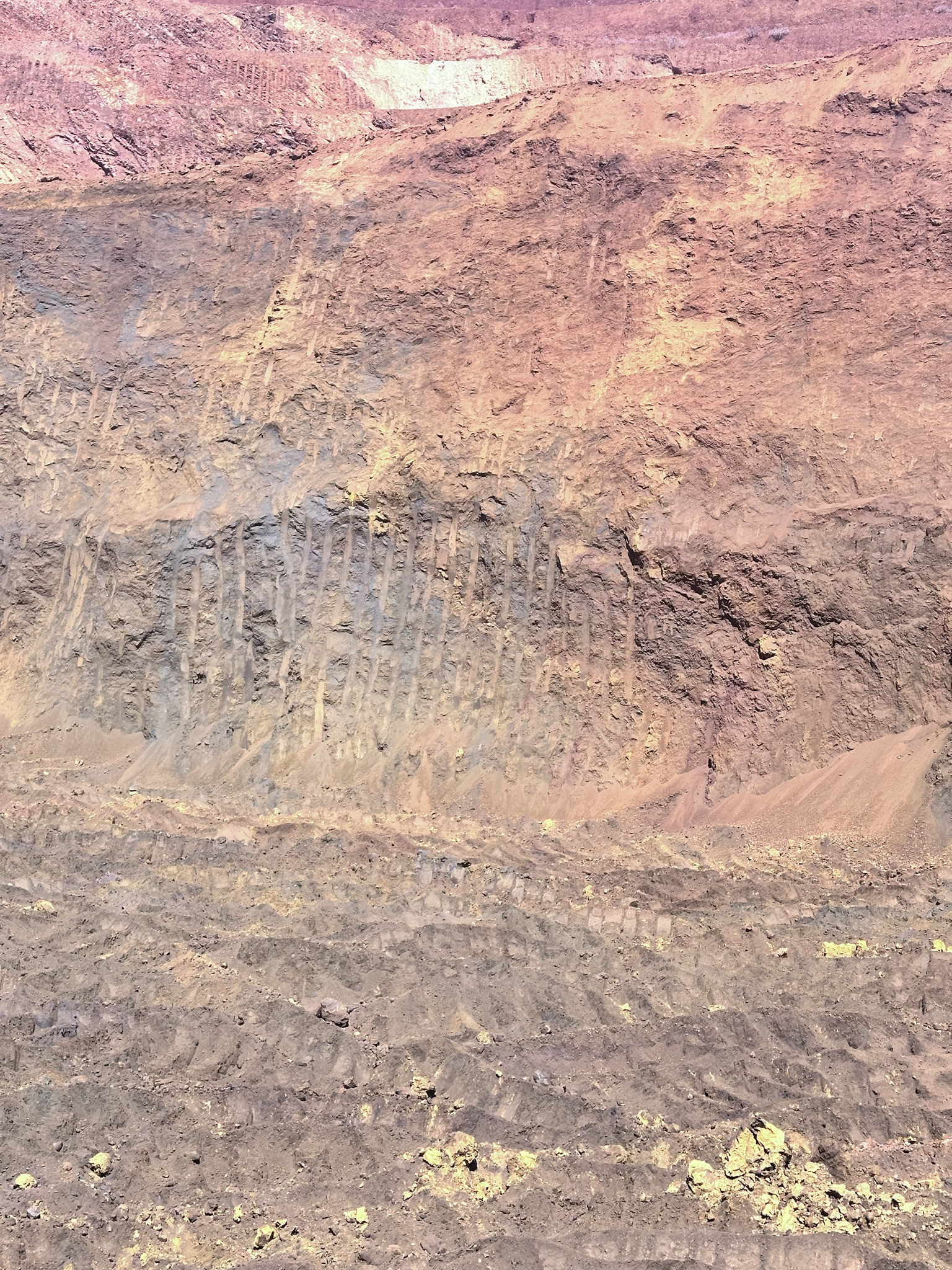
Geology note: why the rock changes color
The color contrast in my photograph deserves a closer look. Iron-bearing minerals help give much of the Australian landscape its red color, but an iron-rich rock face can contain several minerals, surface coatings and textures.7 The same element can appear very different depending on its chemical and physical form.
| Color in the rock | What can produce it |
|---|---|
| Rust-red, pink and red-brown | Finely dispersed hematite, an iron oxide, can color rock or coat its surface. A red surface does not establish how much iron lies underneath. |
| Yellow-brown and ochre | Goethite and related weathering products often contribute these earthy colors. |
| Dark gray and nearly black | Iron minerals can also be dark: metallic hematite may be gray-black, and magnetite is another possibility. Dark color alone does not identify either one. |
Scroll sideways to see the full table →
These are general geological explanations, not mineral labels assigned to individual patches in the image. Hematite is a useful example of the ambiguity: its earthy varieties can be red-brown while its metallic varieties look almost black.8 Goethite and limonite commonly provide yellow-brown pigments.9 Sunlight, shadow, moisture and dust further change what a camera records.
The layers add another question. Banded iron formations, found in Western Australia, contain alternating iron-oxide and silica-rich layers. Even the silica-rich chert can be red or brown.10 That gives context for the contrast without establishing that every visible band in this particular face has the same origin or composition.
For me, this connects the photograph to sensing: an obvious visual difference is a reason to investigate. Turning it into a useful decision—what to mine, separate or process—requires representative samples and validated measurements. A color is a clue, not an assay.
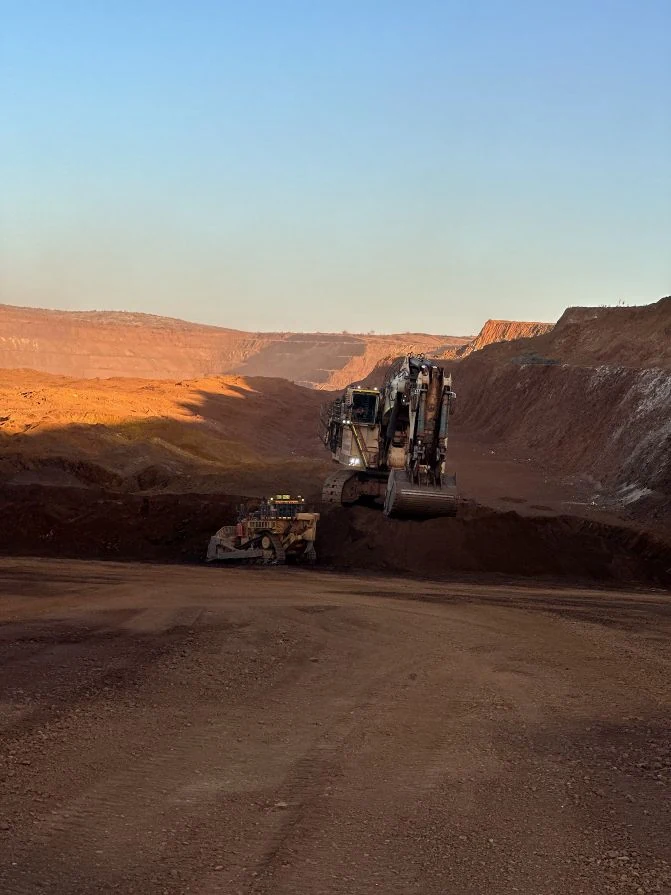
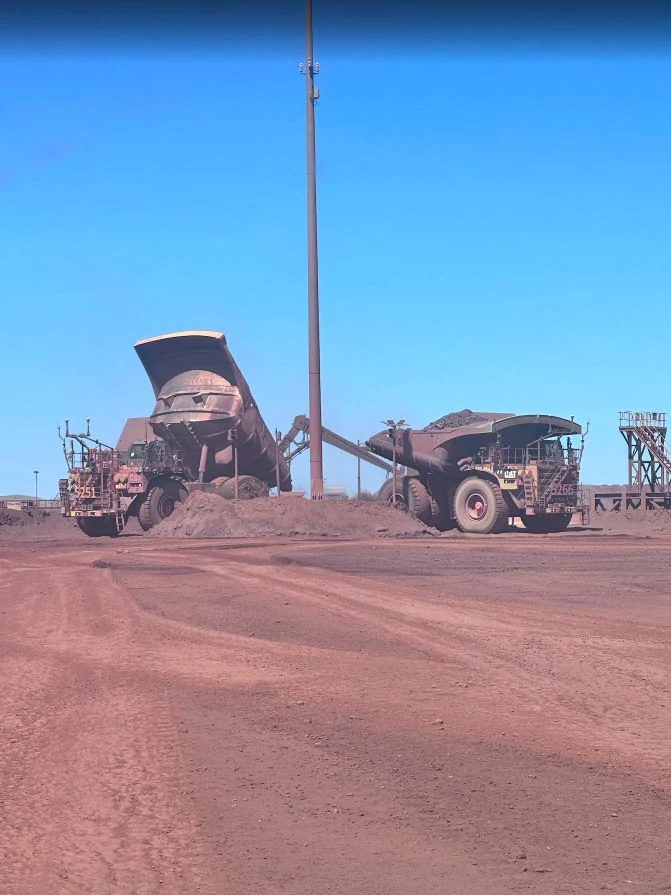
From an autonomous truck to a productive operation
The visible achievement is a truck that can move without a driver in its cab. The commercial question is what happens to the entire operation around it.
I now use three levels to organize that question. First, can the machine perform its assigned task? Second, can the operation repeatedly accept its output, including the work needed to support it? Third, does the improvement matter to a constraint the customer is willing to pay to remove?
That progression—from capability, to dependable work, to economic consequence—is the part of my journey I want to carry into other fields. It connects mining to the questions I ask about physical AI and the cost of learning in hardware.
For a public reference point, BHP describes Jimblebar as an open-cut iron-ore mine near Newman in Western Australia. Its first fully autonomous haul-truck fleet there was completed in 2017. BHP reports lower exposure to driving hazards, productivity benefits and opportunities to develop new workforce skills.1 The milestone concerns the haul-truck fleet; it does not mean every part of the mine operates autonomously.
The distinction matters. A machine operates inside a production system. Loading, hauling, processing, maintenance and the availability of people and power all affect what that system can deliver. These are general engineering relationships, not a description of private conditions at a customer site.
Consider a deliberately simplified example: if downstream processing is already the binding limit, moving material toward it faster may create a larger queue. A better local number can coexist with unchanged useful output. The valuable intervention is the one that changes the actual constraint.
I would therefore evaluate an autonomous deployment through a complete shift and its accepted production. I would ask about total cost, time in service, the human work required to keep it running, safe recovery from exceptions, and whether the improvement survives ordinary variation. Each of those questions needs evidence. A compelling demonstration cannot answer all of them.
People remain part of the achievement
Autonomy changes what people do and where they do it. It creates responsibilities for operating boundaries, maintenance, supervision and recovery. I would judge a deployment partly by whether those responsibilities are clear and whether the people carrying them have the training and authority they need.
Safety belongs in that evaluation as its own objective. Removing someone from one hazard is valuable; the remaining system still needs to be assessed on its own terms. A productivity gain cannot stand in for that assessment.
This is also why I resist assigning the achievement to a single algorithm. Reliable production brings engineering, operations and service together. The coordination is part of the product.
Caterpillar’s public 2025 Annual Report highlights report 827 autonomous haul trucks in operation. That is a company-wide fleet figure, not a count from my trip. The same report describes expanding large-engine capacity and gas-turbine production, and collaborations on on-site power.2 Read together, those disclosures show a company participating in both the automation of physical work and the infrastructure that powers economic activity.
AI brings us back to electricity and materials
My broader interest is in sustained, scaling scarcities: needs that keep growing and remain difficult to meet. Energy is a useful example because an improvement in software still has to fit within a physical supply system.
The IEA’s 2026 update puts global data-center electricity consumption at 485 terawatt-hours in 2025 and projects about 950 TWh in 2030 in its central case. That is total data-center demand, including work beyond AI, and the 2030 figure is a projection. The IEA also identifies constraints in electricity connections and equipment supply.3
My interpretation is that the opportunity extends beyond the model. A customer may need computing capacity, dependable electricity, equipment that can arrive on time, or a way to operate within a constrained grid connection. Each need can create a different business.
The materials connection is broader still. Power systems and industrial infrastructure require physical materials and the equipment to produce and install them. Mining is one part of that chain. But a global demand story does not establish that a particular mine should expand, that a particular machine will sell, or that every supplier will earn attractive returns.
Ore quality illustrates why the details matter. In a simplified mass balance, holding recovery and other conditions constant, a lower concentration of the desired mineral means processing more ore for the same recovered output. The relevant question becomes useful material recovered per unit of work, energy and capital. This is a general relationship; the photograph above and this essay make no claim about the grade or performance of a specific deposit.
That is where sensing, autonomy and energy efficiency become interesting to me: where they can change an expensive physical constraint and where that improvement can be measured.
Caterpillar public investor report: the energy-growth connection
Source: Caterpillar Q3 2026 financial results, published 29 October 2026. The figures below are reported sales measures, not share-price returns.4
| US dollars, billions | Q3 2025 | Q3 2026 | Reported growth |
|---|---|---|---|
| Consolidated sales and revenues | 17.638 | 20.682 | 17% |
| Power Generation application sales | 2.634 | 3.421 | 30% |
| Power & Energy total segment sales | 7.463 | 8.784 | 18% |
| Resource Industries total segment sales | 3.999 | 4.615 | 15% |
Scroll sideways to see the full table →
Caterpillar links power-generation growth mainly to turbines and related services, and large engines primarily for data centers. That provides a direct, publicly reported connection between demand for power equipment and business growth.
The mining/heavy-construction/quarry increase primarily reflected dealer-inventory changes. It should not be attributed wholesale to AI. Segment totals include intersegment sales and cannot be added to consolidated revenue.
The comparison uses the release’s own presentation. Caterpillar renamed Energy & Transportation to Power & Energy in 2025 and moved Rail into Resource Industries in January 2026, as explained in its annual-report highlights.
The investment question remains harder than the revenue question. For full-year 2025, Caterpillar reported revenue rising 4% to $67.6 billion while its GAAP operating margin fell from 20.2% to 16.5%.5 A growing need can coexist with cost pressure, execution risk or an expensive valuation. I would want to understand who captures the value, the capital required to serve demand, and what is already reflected in the price.
Electrification adds another system to coordinate
A later public development extends the story. In June 2026, Caterpillar announced a trial with BHP and Rio Tinto involving two Cat 793 XE Early Learner battery-electric haul trucks at Jimblebar. The announcement describes evaluation of technical readiness, infrastructure and commercial feasibility, including charging.6 This is a subsequent industry example, not something I am claiming to have witnessed during my visit.
Autonomy and electrification address different questions. One concerns how a machine is operated; the other concerns how it receives and uses energy. Combining them creates another coordination problem: the production plan and the energy plan have to work together.
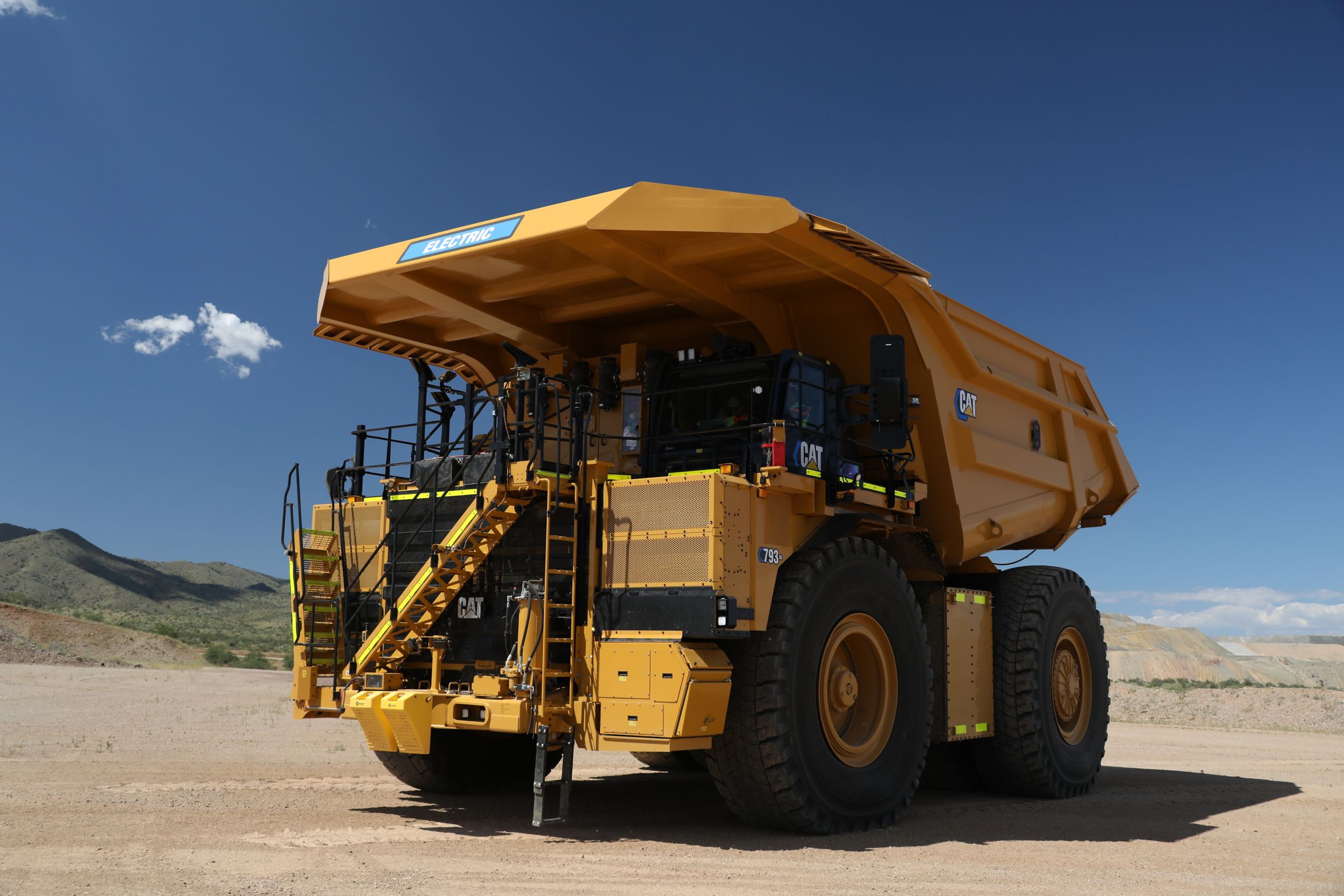

Caterpillar’s 2024 release describes testing seven Early Learner trucks and moving into customer-site validation.11 The photographs put a machine around the engineering question: can the truck, charging infrastructure and operating schedule repeatedly deliver useful work together?
As a general evaluation framework, I would want to know how charging fits around productive work, what power is available when it is needed, how the site handles interruptions, and whether savings survive the infrastructure and maintenance costs. Those are questions for a deployment study, not answers supplied by the announcement of a trial.
What I carry forward
The BHP visit belongs to a continuing journey in how I think about technology. Engineering draws my attention to what a system can do. Strategy asks whose problem it changes. Commercialization asks whether that change survives cost, repetition and responsibility.
I want to keep those questions together. Mining is a useful place to practice because the output is physical and the dependencies are difficult to hide. The same discipline applies to a robot, a material sensor or a new source of power: define the useful outcome, find the constraint, and measure the work required to remove it.
The next impressive machine will deserve attention. I will also want to understand the operation that makes it useful—and the energy system that allows it to keep working.
Scope: personal reflection and analysis of the public sources linked below. No internal Caterpillar documents, customer operating records, private performance metrics or nonpublic product plans are reproduced. Company-reported outcomes are identified as such; the interpretations and evaluation questions are my own.
Sources & notes
- BHP · Celebrating 10 years of Jimblebar (2023) ↗
Public company account, 18 September 2023. Establishes the mine’s location, commodity and 2017 autonomous-haulage milestone. Company-reported benefits are not an independent safety or productivity audit.
↩ Return to text - Caterpillar public investor report · 2025 Annual Report highlights ↗
Public annual-report material. Reports the autonomous haul-truck fleet, investment in power capacity and segment reorganization. The fleet figure is company-wide, not a count from my visit.
↩ Return to text - IEA · Key Questions on Energy and AI (2026) ↗
Updated global data-center electricity outlook. The 2030 number is the IEA’s central projection; total data-center demand includes workloads beyond AI.
↩ Return to text - Caterpillar public investor report · Q3 2026 financial results ↗
Published 29 October 2026; printed pages 2, 6 and 8. The table uses the comparative periods presented in this release. Segment totals include intersegment sales; application sales and consolidated revenue have different scopes.
↩ Return to text - Caterpillar public investor report · Full-year 2025 results ↗
Published 29 January 2026. Provides the annual revenue and GAAP operating-margin comparison, illustrating why sales growth and profitability must be evaluated separately.
↩ Return to text - Caterpillar · BHP and Rio Tinto battery-electric haul-truck trial (2026) ↗
Public news release, 23 June 2026. A subsequent industry development, not an event I claim to have witnessed on my visit. Describes an early trial rather than commercial fleet-wide validation.
↩ Return to text - Geoscience Australia · Iron ↗
Background on iron minerals, red coloration and the formation of Australian iron deposits. It does not identify the minerals or grade in my photograph.
↩ Return to text - University of Minnesota · Hematite ↗
Explains why hematite can appear red-brown or metallic gray-black, and why appearance alone cannot distinguish it from other minerals.
↩ Return to text - Virginia Energy · Iron Oxide Pigments ↗
Geological Survey description of red hematite pigments and yellow-brown goethite and limonite pigments.
↩ Return to text - Australian Museum · Banded iron formation ↗
Regional geological context: alternating iron-oxide and silica-rich layers, including red and brown chert. The museum specimen is not a sample from my visit.
↩ Return to text - Caterpillar · 793 XE Early Learner testing and validation (2024) ↗
Public September 2024 release and equipment photo gallery. The two credited photographs show Caterpillar’s battery-electric truck program at its Arizona proving ground; they are not photographs of my BHP visit.
↩ Return to text
Notebook · Published 2026-11-02
Editorial method & provenance
Responses & questions.
What am I missing? Share a correction, counterargument, or relevant experience.
Loading responses…
Add a public comment
Send me a private note about this article
About: Autonomous mining: from the pit to the power system